
From the 30-share Sensex pack, NTPC, Asian Paints, HDFC Bank, State Bank of India, Tata Motors, JSW Steel, Maruti and Power Grid were among the major laggards. On the other hand, Sun Pharma, Infosys and ICICI Bank were the gainers.

Among the Sensex firms, Asian Paints, Titan, Larsen & Toubro, JSW Steel, ITC, Hindustan Unilever, Maruti and Reliance Industries were the major gainers. ICICI Bank, NTPC, Infosys, Tech Mahindra, Tata Steel and Bajaj Finance were among the laggards.

In response to the panic triggered by Trump's trade policies, the RBI net sold approximately $43 billion in the second half of FY25 to curb volatility, as the rupee plunged to a low of 87.95 per dollar in February this year.

From the 30-share blue-chip pack, Adani Ports dropped over 4 per cent. UltraTech Cement, Sun Pharma, IndusInd Bank, NTPC and Tata Steel were also the among the laggards. Nestle, ICICI Bank, Infosys, Tata Consultancy Services and HCL Tech were among the gainers.

The World Bank on Tuesday raised the growth forecast for the Indian economy to 7 per cent for the current fiscal year on the back of recovery in agri sector and rural demand. World Bank had in June projected India to grow at 6.6 per cent for FY24. According to the World Bank Report released on Tuesday, India's growth continues to be strong despite a challenging global environment.

The primary market is expected to remain vibrant, with at least 10 companies, including supermart major Vishal Mega Mart and Blackstone-owned diamond grading firm International Gemmological Institute (India) Ltd expected to raise a combined Rs 20,000 crore in the next month, merchant bankers said. Education-focused NBFC Avanse Financial Services, TPG Capital-backed Sai Life Sciences, hospital chain operator Paras Healthcare, and investment bank DAM Capital Advisors are also among the companies planning to launch their IPOs in December, they added. The companies aim to raise a total of Rs 20,000 crore through their public offerings.

Among the Sensex firms, JSW Steel, Titan, Tata Steel, Sun Pharma, Reliance Industries, Bharti Airtel, Tata Motors and HDFC Bank were the biggest gainers. NTPC, Tech Mahindra, Maruti, State Bank of India and Larsen & Toubro were among the laggards.

Among the Sensex firms, Kotak Mahindra Bank, UltraTech Cement, Mahindra & Mahindra, Larsen & Toubro, ICICI Bank, IndusInd Bank, Wipro and Hindustan Unilever were the major laggards. Sun Pharma, Bajaj Finance, Bharti Airtel, Reliance Industries, Bajaj Finserv and Titan were among the winners.

Gold prices advanced Rs 700 to reach a new lifetime high of Rs 91,950 per 10 grams in the national capital on Wednesday on the back of continued buying by jewellers ahead of wedding season, according to the All India Sarafa Association. Besides, increased tensions in the Middle East and concerns about the US economic slowdown have kept the demand for safe-haven assets intact.

The sector seems set for a rally that may be somewhat temporary.

Organise your PAN, Form 16, Form 26AS, AIS, and all other proofs before e-filing.
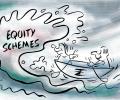
The information and technology (IT) sector, which has been going through a rough patch lately, was among the top draws for equity mutual funds (MFs) in July. MF schemes together invested a net of Rs 1,800 crores in IT stocks last month after pulling out around Rs 700 crore from the sector in June, according to a report by ICICI Securities.

Fintech firm BharatPe is targeting an initial public offering (IPO) in the next 18-24 months with the company expecting profitability at an earnings before interest, taxes, depreciation and ammotisation (Ebitda) level for FY25, chief executive officer (CEO) Nalin Negi said.
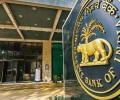
The Reserve Bank of India (RBI) has barred four non-banking finance companies (NBFCs), including two microfinance institutions (MFIs), from sanctioning and disbursing loans for charging exorbitant interest rates to the borrowers. These four entities are Asirvad Microfinance, Arohan Financial Services (also an MFI), DMI Finance, which provides personal, consumption, and micro, small and medium enterprises loans, and Flipkart co-founder Sachin Bansal's Navi Finserv, which offers home and personal loans. The ban will take effect on October 21 to "facilitate closure of transactions in the pipeline", the regulator said in a statement.
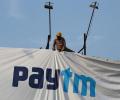
The Reserve Bank of India (RBI) has barred Paytm Payments Bank from most operations, including taking deposits and fund transfers with effect from March 1, 2024. The curbs on the bank come amid several alleged failures such as violations of know-your-customer (KYC) norms. Under such a scenario, here's what works for customers using Paytm Payments Bank, according to the company.

Front-running is a fraudulent practice where traders exploit advance knowledge of large client orders for personal profit.

From the 30 Sensex firms, Mahindra & Mahindra, State Bank of India, Bharti Airtel, Hindustan Unilever, Kotak Mahindra Bank, UltraTech Cement, Adani Ports, and Tata Steel were the biggest gainers. ICICI Bank, IndusInd Bank, Asian Paints, Tech Mahindra, Infosys, HCL Technologies, Tata Consultancy Services, and Larsen & Toubro were among the laggards.

Equity benchmark indices Sensex and Nifty settled lower for the sixth straight session on Monday due to heavy selling in bellwether stocks including HDFC Bank and Reliance Industries amid mixed trends in the global markets and outflow of foreign funds. Falling for the sixth consecutive session, the BSE Sensex tumbled 638.45 points or 0.78 per cent to settle at 81,050. During the day, it plummeted 962.39 points or 1.17 per cent to 80,726.06. The NSE Nifty slumped 218.85 points or 0.87 per cent to end at 24,795.75.
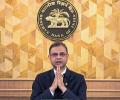
'A repo cut will be very good for the market as it will mean that everything is being done to spur growth in these uncertain times.'

Ritika Gupta, a study abroad expert and founder of Aaera Consultants, explains how Germany's new visa rules will affect international students and working professionals.

'The larger and more opaque this shadow economy becomes, especially online, the greater the risk to India's national security.'

The finance ministry on Friday asked state governments to accord priority to employees of banks and insurance companies for Covid-19 vaccination, saying they are exposed to high risks during these difficult times.
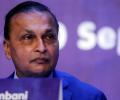
IndusInd International Holdings chairman Ashok Hinduja on Tuesday announced the acquisition of Reliance Capital, completing the three-year-long resolution process of the debt-ridden company. IndusInd International Holdings Ltd (IIHL) has transferred the bid amount to the escrow account of the lender, and the takeover of the management from the Administrator will happen on Wednesday.

Ask rediffGURU and PF expert Milind Vadjikar your insurance, stocks, mutual fund and personal finance-related questions.

The ongoing fourth quarter earnings season, global factors and macroeconomic data would guide the trends in the equity markets this week, analysts said. Markets would also take cues from trading activity of foreign investors, rupee-dollar trend and movement of global oil benchmark Brent crude. "Domestically, the next batch of Q4 earnings reports will drive stock-specific movements, Hero MotoCorp, Larsen & Toubro, BPCL, State Bank of India, Eicher Motors and Tata Motors are some of the big names in the list and the next phase of voting," said Pravesh Gour, senior technical analyst, Swastika Investmart Ltd.
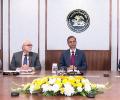
'We never waste a crisis. There will be learning and the supervisory tools will get better with each episode.'

Foreign investors continue to pull back money from the Indian equity market, withdrawing Rs 24,753 crore (about $2.8 billion) in the first week of March amid escalating global trade tensions and lacklustre corporate earnings.

The debt-ridden IL&FS group has discharged Rs 45,281 crore to its creditors as of March 2025, completing the resolution of its 197 entities, according to the latest status report affidavit filed before the insolvency appellate tribunal NCLAT. This is 18.9 per cent higher than Rs 38,082 crore, the amount of debt that stood resolved from the last status report filed by IL&FS six months before on October 28, 2024.
Benchmark equity indices Sensex and Nifty slumped over 1 per cent on Friday, tracking a weak trend in global markets and fresh foreign fund outflows. Falling for the third day running, the 30-share BSE Sensex tumbled 1,017.23 points or 1.24 per cent to settle at 81,183.93.

With short-term rates firming up due to tight liquidity conditions, Indian corporates are opting to borrow long term to take advantage of the attractive rates by locking them in these uncertain times. The banking system has a liquidity deficit of over Rs 2 trillion. According to market participants, engineering conglomerate Larsen & Toubro (L&T) raised Rs 1,500 crore through 10-year bonds in December 2024.

Nineteen per cent of global fund managers remain bullish on India, suggests the latest BofA Asia Fund Manager Survey (FMS). A total of 249 panelists with $656 billion worth of assets under management (AUM) participated in the survey between February 2 and 8, BofA said. Two hundred and nine participants with $568 billion AUM responded to the global FMS questions, while 145 participants with $331 billion in AUM responded to the regional fund manager survey (FMS) questions, BofA said.

Benchmark stock indices Sensex and Nifty closed with losses in a choppy trade on Thursday as investors preferred a cautious approach ahead of inflation and industrial production data to be released later in the day. Unabated foreign fund outflows also hit the investor sentiment. The 30-share BSE Sensex declined by 147.47 points or 0.25 per cent to settle at 59,958.03.

From the 30-share blue-chip pack, Zomato cracked nearly 7 per cent. Power Grid, Adani Ports, Tata Steel, NTPC, Tata Motors, Tech Mahindra, Mahindra & Mahindra, Asian Paints, Sun Pharma and UltraTech Cement were the other major laggards. In contrast, Axis Bank, Hindustan Unilever, Tata Consultancy Services and IndusInd Bank were the gainers.

Tata Motors, State Bank of India, UltraTech Cement, Tata Consultancy Services, Tata Steel and Asian Paints were among the other laggards from the 30-share pack. Maruti, Bharti Airtel, Power Grid, Hindustan Unilever and HDFC Bank were among the gainers.

State Bank of India, Adani Ports, Tata Consultancy Services, ICICI Bank, Reliance Industries and PowerGrid were also among the laggards.
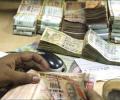
Readying itself for a bank licence, Anil Ambani-led group's Reliance Capital on Wednesday said Japan's Sumitomo Mitsui Bank and Nippon Life would become its strategic partners in the proposed banking venture, with each having 4-5 per cent stake.

Quarterly earnings of corporates, trading activity of foreign investors and inflation data are the key factors that are expected to drive the momentum in the equity markets this week, analysts said.

'If their allocation to certain segments have become high due to strong returns over the past three-four years, they should rebalance their portfolios and bring them in line with their long-term asset allocation.'

Since infrastructure projects have long gestation periods, investors need to enter them with a long horizon of at least 10 years.
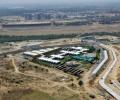
Standard Chartered Bank is setting up an international banking unit primarily to look after Indian company requirements. The bank is looking for a $2-billion loan book in the first five years of business.
